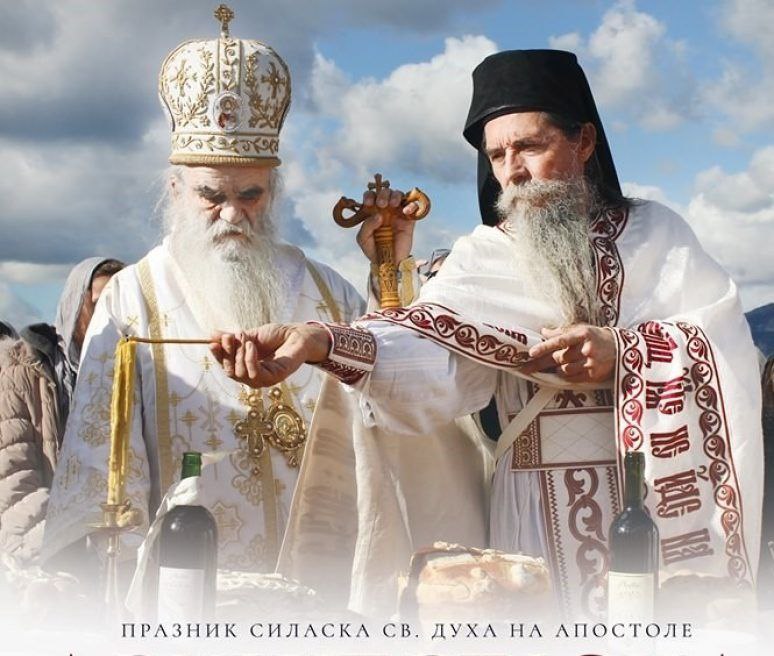
The Monastery of the Holy Archangel Michael is a truly extraordinary place, drenched in flowers, surrounded by the waters of the Bay of Tivat, with views of the Luštica peninsula on one side and Tivat on the other. Here you simply want to be — to be, and to be still — and Father Benedict, the monastery's abbot, a man of remarkable beauty of spirit, seems to radiate calm, goodness, and light. Services are held under the open sky, beneath the shade of olive and pine trees.
The Monastery of the Holy Archangel Michael, on the island of Miholjska Prevlaka (the Island of Flowers), has an ancient history and was once the main center of Orthodoxy in Montenegro. The first Christian churches began appearing on the island as early as the 4th–6th centuries. In the early 13th century, Archbishop Sava I of Serbia founded the Monastery of the Holy Archangel Michael on the island, and in the 14th century, Tsar Dušan established here the seat of the metropolitans of the Principality of Zeta (a medieval Slavic principality occupying the territory of present-day Montenegro), raising the Zeta diocese to the rank of metropolitanate. The seat of the Zeta diocese remained here until the mid-15th century.
After the collapse of the Serbian empire, Kotor voluntarily submitted to the rule of Hungary and Bosnia, and from 1420 became a Venetian city. Control of the monastery's land holdings became the chief aim of the local nobility, and the expropriation of monastery lands began. In 1441, as a result of intrigues by the Venetian nobility, seventy monks serving at the monastery were poisoned during a festive meal, and the monastery was destroyed. Over the years, the island fell into ruin. The remains of the holy martyrs' relics are kept at the monastery to this day.
In the first half of the 19th century, the first attempt was made to restore the monastery. In 1827, Countess Ekaterina Vlastelinović purchased part of the island and began work to improve it. Then in 1833, in memory of the murdered monks, the Church of the Holy Trinity was built on the site of the Monastery of the Holy Archangel Michael. In 1847, the countess died under unclear circumstances, and restoration of the monastery came to a halt for more than a century. The countess is buried here, beside the church, and her grave is a site of pilgrimage for Orthodox Christians.
Restoration work on the monastery continues to this day.