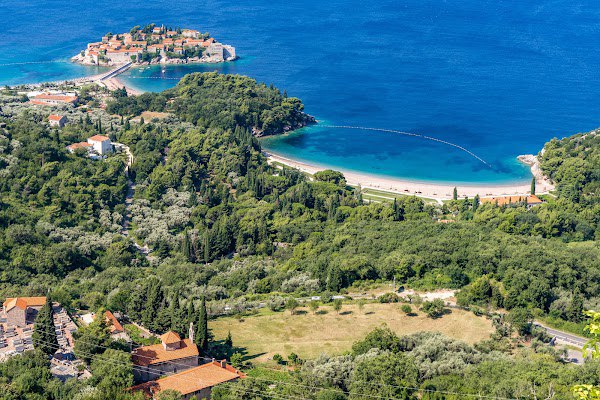
Praskvica Monastery remains one of Montenegro's most cherished places.
The monastery, home to the Church of Saint Nicholas (whose icon was consecrated in Jerusalem), sits on a mountain slope, offering a breathtaking panoramic view over the entire Budva Riviera — from the island of Sveti Stefan, Montenegro's postcard image (extraordinarily picturesque and famous for the celebrities who once lived there), to the old town of Budva and the island of Saint Nicholas (known locally as "Hawaii").
The monks here work tirelessly: they grow their own vegetables and fruit, gather medicinal herbs, keep beehives and receive their own honey as a gift from the bees, and in autumn harvest olives (helped by the nuns from the Rustovo monastery higher up the mountain — more on that another time) to produce their own olive oil.
Here you can sit on a wooden bench or the low stone wall by the church and take in sea views framed by orange, olive, and fig trees, listening to birdsong and the bleating of sheep — and if you're lucky, to stories from Father Dimitri, who has been the monastery's abbot for half a century now, as he sorts through bitter wormwood herb for the monastery's meal.
It was here that I met a Russian-speaking Muslim man from Germany, who by then had already been living at the monastery for several months. When I asked Father Dimitri about differing faiths, he simply shrugged and said quietly — or perhaps didn't say it at all, but I heard it all the same — "We welcome everyone."
Here, in the Church of Saint Nicholas, there's a small vaulted chamber with ancient frescoes, where it's good to listen to the silence — it has something to tell.
And it was here that the Russian count Yegor Stroganov found refuge, and later, his daughter, disguised as a monk. Their graves are within the monastery walls… that remarkable story is one for when we meet in person. I'll only say that the count laid out the path to the mountain's summit — one I hope we'll follow, since both the walk itself and the view from the top are mesmerizing.
Praskvica Monastery is considered one of the region's most significant spiritual and historical monuments. Its treasury holds a number of unique relics, among them:
- A golden cross, believed to have belonged to Tsar Dušan.
- A chalice (paten) belonging to Russian Emperor Paul I, gifted in 1798.
- Deeds of gift from Empress Catherine II (1783 and 1798).
- A handwritten Gospel from 1600, a gift from Metropolitan Danilo.
- A Typikon from 1713 and a Menaion from 1717.
- Roughly 5,000 books, including manuscripts and early printed editions.
- A stone "table of truth," where the council of the Paštrović family — who held these lands for many centuries — once convened.
According to tradition, the monastery was founded in 1050, though the first written mention of it dates to 1307, when the Serbian king Milutin confirmed the monastery's right to the villages granted to it by his mother, Queen Helen.
The monastery complex includes two churches — the Holy Trinity and Saint Nicholas.
The Church of the Holy Trinity was painted in 1681 by the renowned icon painter Radul, and its iconostasis was created by his student, Dimitrije Daskal, in the early 18th century.
The Church of Saint Nicholas was founded in 1413 and took on its present form in 1847, thanks to the work of Archimandrite Sinesije Davidović and the help of monks and Russian patrons. Its iconostasis was painted by the Greek icon painter Nikolaos Aspioti in 1863.